
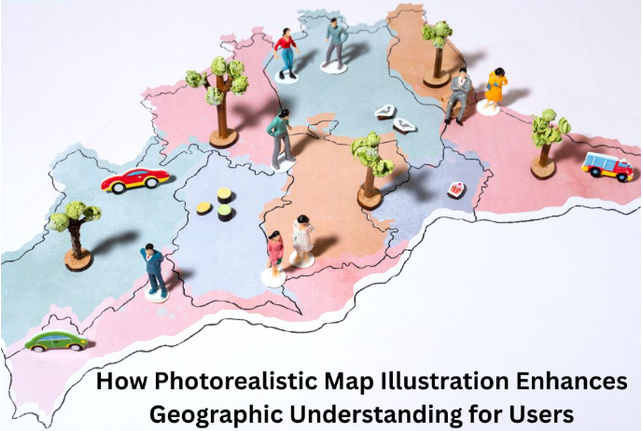


A clear understanding of geography has emerged as an integral function within the interactions people have with online platforms. Whether it be an examination of a new property offering, an examination of a travel destination, an interpretation of global environmental information, or learning about city infrastructure, people have increasingly come to expect images that are easy to interpret and have a high degree of realism. As a result, there has been a rapid adoption rate associated with photorealistic map illustrations.
Unlike conventional maps, these graphics imitate the texture, colors, light effects, and perspective of real-world geography so that the user can grasp geographic information on a more detailed and intuitive level.
Often, these graphics are coupled with highly detailed architectural graphics, particularly if map graphics include maps involving buildings, infrastructural developments, or proposed developments. All these tools combine to provide an engaging and informative geographic experience.
Below are ways that photorealistic mapping helps with understanding geography.
1. Adding Real-World Visual Cues for Faster Comprehension
A conventional map uses symbols, colors, and abstract designs. Although useful, these maps may have previously required pre-existing knowledge about geography. A more realistic representation of the map addresses these limitations and depicts landmasses, architecture, and geography as they appear in nature.
Users develop better spatial understanding because they are able to identify:
- Nature-based features: river, coastline, and forest.
- Road Networks and Transport Routes
- Land-use planning and geospatial representation
- Variations and changes in terrain elevation
- Terrains
By providing a real-world visual perspective, it becomes easier for people to understand information.
2. Improving Spatial Awareness with Depth and Accuracy
However, because traditional maps are two-dimensional, there is no Depth Perception. Pictures on a map cannot effectively convey Height or Heights. However, with Photorealistic Maps, there are shadow effects and perspective considerations, which make it more three-dimensional.
It’s particularly useful for:
- Urban planning
- Outdoor recreation maps
- Outdoor recreation
- Environmental Assessments
- Property Development Presentations
As users are able to perceive height, gradient, and contour information with the naked eye, it enhances user understanding of geography.
3. Improving Complex Information Access and Use
A great deal of geographic data, be it zoning regulations, proposed developments, or environmental reports, can be extremely daunting as text or numbers. The equivalent visualization as a photorealistic map representation will make it meaningful.
By incorporating buildings created with the use of photorealistic architectural rendering skills, it becomes easier to communicate:
- Phases of Construction
- Transport networks
- Infrastructure
- Land-use changes
- Neighborhood designs
- Community
The importance of clarity becomes even more pronounced within the specific context of communicating with a lay audience, as with prospective house-buyers or members within a public forum.
4. Facilitating Better Navigation and Orientation
Users find realistic graphics more naturally understood than symbols and two-dimensional graphics. Photorealistic maps are reflections of familiar geography, enabling people to locate themselves.
These offer intuitive clues, including:
- Landmark identification
- Raster graphics
- Relative Distances
- Land-based methods
Whether it is for tourist purposes, organizing an event, or developing an outside recreation app, these maps improve the user’s knowledge about their location and ways to get to their destination.
5. Enhancing Decision-Making Processes for Real Estate and Development Initiatives
Property buyers want more than property boundaries on a map. They want a sense of community layout, local conveniences, and character associated with local geography. Builders and marketers are increasingly applying map illustrations with a high degree of realism.
Combined with architectural rendering, maps can display:
- Visual relationships amongst structures
- Access points, green areas, and neighborhood flow
- The vista from planned developments
A transparency of this degree fosters trust and more confident investment actions.
6. Improving Educational and Research Use
Students and researchers rely on visual aids for understanding geography, geology, and climate. A photorealistic map creates an interactive learning experience with a realistic interpretation of geography.
They assist people learn:
- Climate change
- Terrain morphology
- Types of city growth
- Ecosystem distribution
By connecting scientific information with visualization, these maps allow geographic education to be more interactive and impactful.
7. Improving Public Communication for Large Projects
When planning new infrastructure projects, such as road developments and environmental projects, it becomes imperative for governments and private agencies to get approval from the people. The blueprint designs depicted on a map have often caused confusion.
A map illustration with a degree of photorealism clearly relates because it depicts:
- The overall look of an intended project
- Its relationship with the external world
- Visual benefits – ‘green space’ or traffic improvements
- Detailing Spatial Accuracy without Burdening with Technical Information
Together with the use of photorealistic architectural visualization, there is a compelling narrative offered here that can greatly improve transparency and citizen support.
Conclusion
Photorealistic map illustration can greatly improve geographic knowledge with detailed and realistic images of the world. Whether it is for real estate purposes, educational illustrations, tourism, planning, or environmental graphics, these illustrations help people make sense of information with ease and accuracy. A combination of these illustrations and photorealistic architectural illustrations would result in an engaging and comprehensive visualization that connects creativity with reality.
While industries increasingly adapt to a visual-first pattern of communications, the role of photorealistic mapping as an essential component for enhancing user experience and understanding geography will remain an imperative.